

For decades, BFBS has used geostationary satellite distribution as the default method for delivering broadcast services into remote and hard-to-reach locations. But changes in global connectivity, and in what modern IP networks are now capable of supporting, are challenging long-held assumptions about how broadcast services should be delivered.
Our recent and ongoing project with BFBS illustrates how IP-based delivery has matured into a viable, resilient alternative, even for mission-critical services.
Why BFBS Needed to Change
Innovation, service improvement, and providing value for money is what BFBS strives to achieve in providing global welfare services to the British Armed Forces across the globe, and in some of the most remote and unusual locations imaginable.
From the end of September 2023, the TV and radio services to Diego Garcia, Brunei, and Nepal were to be delivered via internet connectivity. At the same time, the previous method of service distribution via a geostationary satellite was cancelled. So, why change from a reliable and understood distribution method? Technology has changed.
Moving Time-Critical Broadcast Streams Over IP
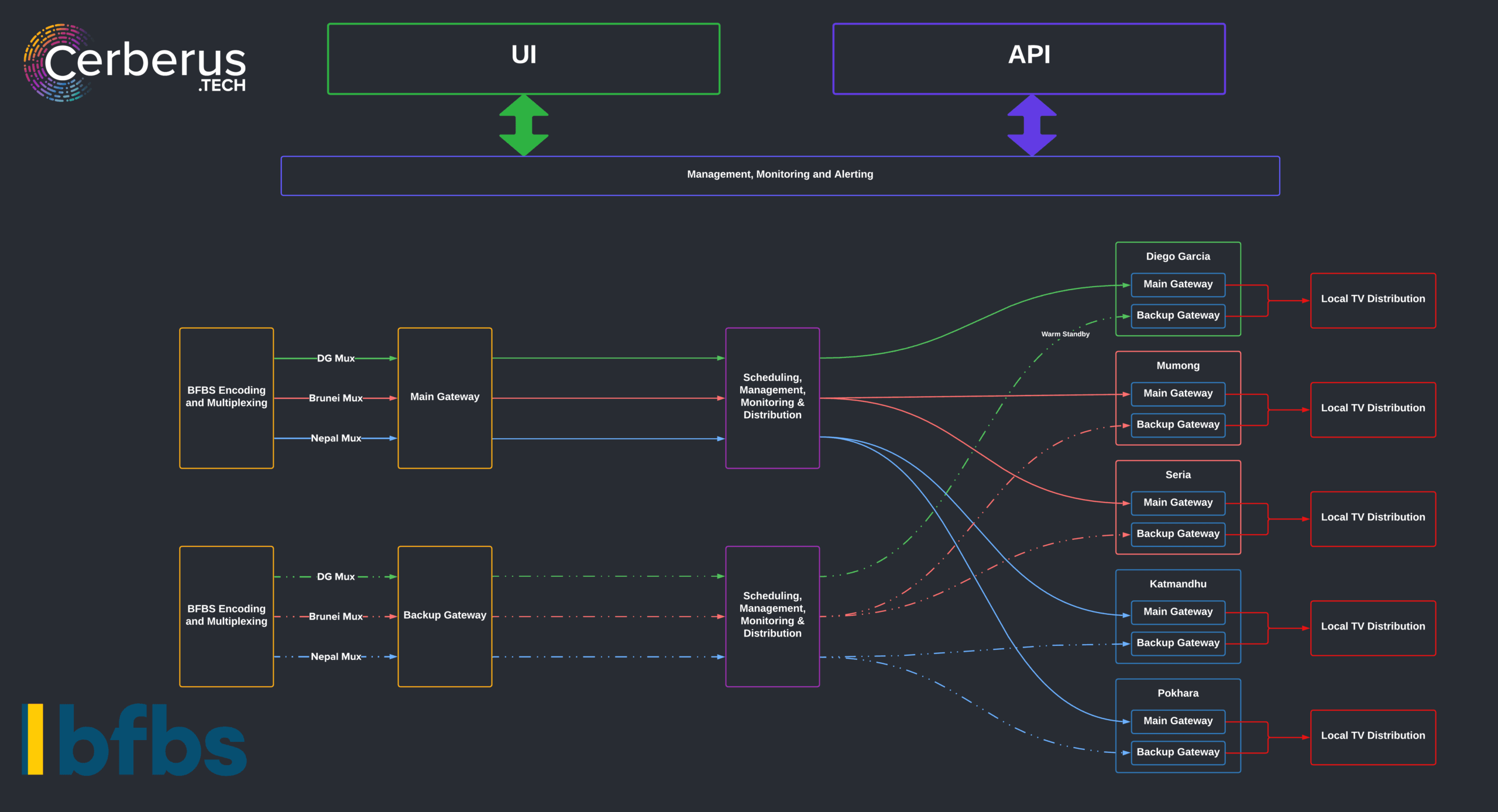
By partnering with Cerberus Tech, BFBS adopted an IP-based approach to delivering its multiplexed transport streams, initially using under-sea fibre to reach Diego Garcia.
Cerberus Tech’s managed service offering provided a robust method of sending time-critical data streams across the internet. Something that, until recently, would not have been possible at the level of reliability required for broadcast services.
Tailored Transport Streams for Each Location
Delivering each location with its own transport stream gave BFBS the ability to improve the service at each site individually. Rather than sharing a time delay targeted at one audience with others, the replacement multiplex project delivered tailored transport streams with specific delays and bespoke channel line-ups for each location.
From March 2024, this approach enabled a noticeably enhanced user experience for audiences in Diego Garcia, Brunei, and Nepal.
Cost Efficiency and Replication at Scale
By cancelling geostationary satellite capacity and moving to IP delivery of transport streams, the transition provided significant cost savings to BFBS, while maintaining service quality.
Following the initial deployment, the work in Diego Garcia was replicated in Brunei, where TV and radio services transitioned to IP delivery at two locations on 1 November. Nepal followed shortly afterwards, with audiences in Kathmandu and Pokhara seamlessly transitioned to the same delivery model.
What Comes Next
BFBS continues to migrate locations to IP delivery where there is a compelling financial and operational case to do so. Ascension Island is currently undergoing a full TV broadcast equipment refresh and will be the next location to be served via our partnership with Cerberus Tech and their IP delivery solutions, this time using a LEO satellite-provisioned internet connection.
Find out more about Cerberus Tech’s work with BFBS here.
If you’re interested in talking to the team about your own project, get in touch today.